


Description
3M 3779 Hot Melt Adhesive: Features, Applications, and Performance
3M 3779 Hot Melt Adhesive is a proven benchmark for demanding bonding applications in industry and craftsmanship.
Formulated with a polyolefin base, it offers excellent adhesion to difficult materials: polypropylene, polyethylene, and low surface energy surfaces.
Its generous open time and thermal resistance make it a reliable choice for applications requiring durability and long-term hold.
Overview of 3M 3779 Hot Melt Adhesive
3M 3779 Hot Melt Adhesive is a polyolefin-based adhesive formulated for industrial applications that require a strong, durable bond on hard-to-bond materials.
It stands out for its ability to adhere to low surface energy surfaces, such as polypropylene (PP) and polyethylene (PE), often without the need for primers or pre-treatment.
Composition and product form
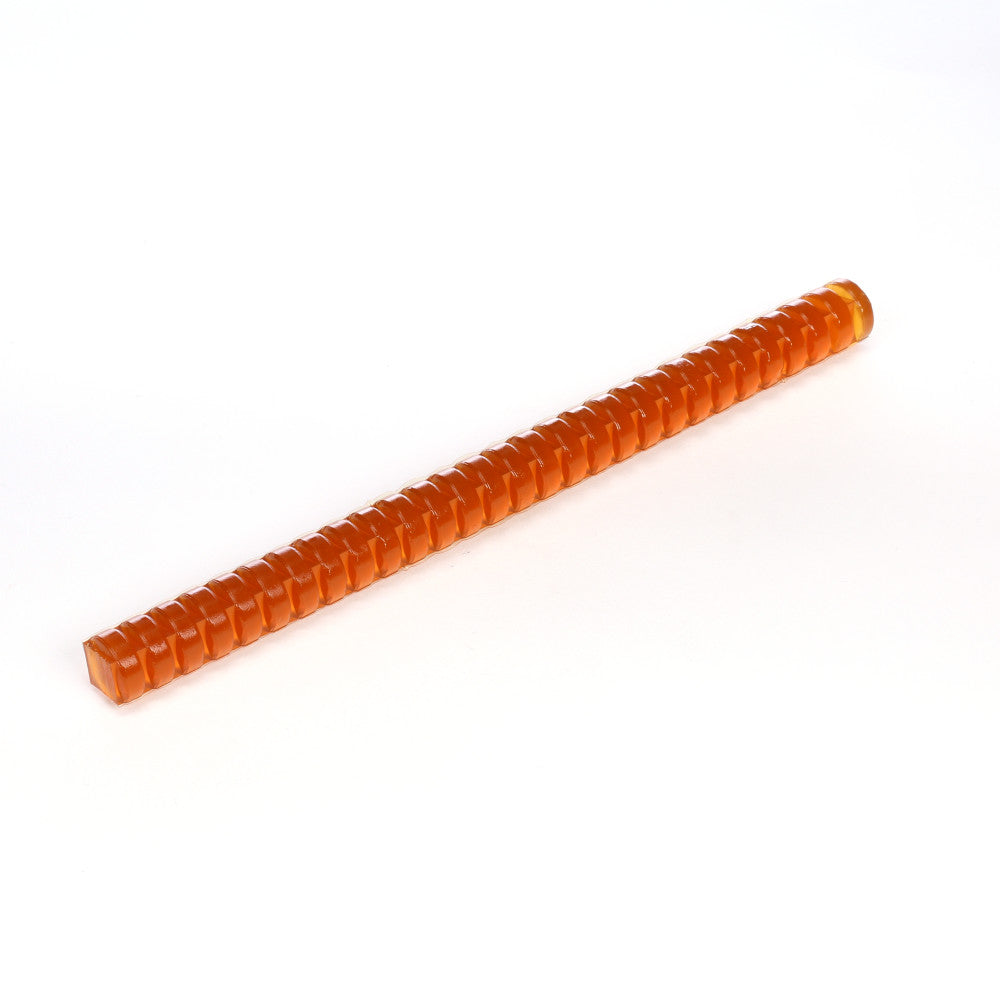
The 3779 comes in the form of cylindrical sticks compatible with standard hot melt glue guns. It is applied in a molten state and solidifies quickly upon cooling.
Its polyolefin formulation provides excellent chemical resistance and good temperature stability once the bond is formed. It remains flexible after cooling, which limits the risk of cracking under mechanical stress.
Here are its main composition characteristics:
- Chemical base: polyolefin
- Form: cylindrical hot melt sticks
- Color: translucent to slightly yellowish
- Application temperature: approximately 190 °C
- Open time: short, adapted to industrial production rates
At Dagobert Industrie, we offer the 3M 3779 to professionals bonding technical plastics, non-wovens, or mixed assemblies that require reliable adhesion on polyolefins.
Technical properties and performance of the 3M 3779
3M 3779 Hot Melt Adhesive is formulated with a polyolefin base. It offers excellent adhesion on a wide range of substrates, including difficult-to-bond low surface energy surfaces.
Its application temperature is around 190 °C. The open time is short, which facilitates fast production cycles.
Once cooled, the adhesive forms a flexible and strong bond. It handles mechanical stresses and vibrations well without cracking.
The 3779 has good in-service temperature resistance, generally up to about 80 °C. It remains stable in environments subjected to moderate thermal variations.
It is compatible with 3M glue guns in the Scotch-Weld range, particularly high-temperature models. It is fed in stick form.
| Product | Chemical Base | Appl. Temp. | Service Temp. | Key Strengths |
|---|---|---|---|---|
| 3M 3779 | Polyolefin | ~190 °C | up to ~80 °C | Low-energy surfaces, flexibility, mechanical strength |
| 3M 3748 | EVA | ~177 °C | up to ~65 °C | General use, wood, cardboard, textile |
| 3M 3792 | Modified EVA | ~177 °C | up to ~60 °C | Long open time, complex assemblies |
| Henkel Technomelt PA 6208 | Polyamide | ~210 °C | up to ~120 °C | High thermal resistance, demanding industrial applications |
Applications and materials compatible with 3M 3779 adhesive
The 3M 3779 hot melt adhesive is a versatile polyolefin-based glue formulated to provide robust adhesion on a wide range of substrates, including surfaces that are difficult to bond.
It effectively adheres to the following materials:
- Plastics: polypropylene (PP), polyethylene (PE), ABS
- Metals: aluminum, steel, stainless steel
- Wood, cardboard, and paper
- Fabrics and non-wovens
- Ceramic and glass
Uses in industrial and electronic sectors
The 3M 3779 is particularly valued in demanding environments where rapid setting and mechanical hold are critical.
In the electronics industry, it is used for component mounting, wiring, and housing assembly. Its low viscosity in the molten state facilitates application on thin or delicate parts.
In general industry, it is used for:
- Assembling plastic and metal parts
- Bonding thermal and acoustic insulation
- Fixing gaskets and profiles
- Packaging and carton sealing in production
It is compatible with 3M hot melt guns from the professional range (3M TC series, notably the 3M TC Dual 200 gun), which ensures consistent and controlled application on production lines and in workshops.
Comparison: 3M 3779 hot melt adhesive vs. other 3M hot melt references
The 3M hot melt range includes several products, each designed for a specific use. Here is how the 3M 3779 compares to other hot melt adhesives from the manufacturer.
| Reference | Application Temperature | Viscosity | Key Strengths | Typical Applications |
|---|---|---|---|---|
| 3M 3779 | ~190 °C | High | Excellent adhesion on plastics and textiles, short open time | Industrial assembly, textile, packaging |
| 3M 3762 | ~177 °C | Low to medium | Good flow, ideal for porous substrates | Wood, paper, cardboard |
| 3M 3748 | ~177 °C | Medium | Increased heat resistance, good temperature stability | Electronics, assemblies exposed to heat |
| 3M 3789 | ~190 °C | High | High mechanical strength, bonding heavy materials | Construction, composite materials |
The 3779 stands out for its high viscosity when hot. It covers surfaces well and stays in place without dripping, even on vertical surfaces.
Compared to the 3762, it offers better hold on plastic materials and synthetic textiles. The 3762 remains more suitable for porous substrates like wood or cardboard.
Compared to the 3748, the 3779 is not the primary choice for very hot environments. The 3748 withstands prolonged temperature increases better, particularly in electronics.
The 3789 targets heavier, structural assemblies. The 3779 is better suited for fast industrial production rates where the cycle time is short.
Usage tips and safety precautions
3M 3779 Hot Melt Adhesive is used with an appropriate glue gun set between 177 °C and 204 °C. Preheat the gun for at least 5 minutes before application.
Apply the glue to a clean, dry, and degreased surface. Any trace of oil, dust, or moisture reduces final adhesion.
Assemble the parts quickly after application: the open time is short. Maintain slight pressure for a few seconds until it sets.
For porous substrates (wood, cardboard, foam), slight preheating of the surface improves wettability and bond strength.
- Never point a hot glue gun at a person.
- Avoid all contact of molten glue with skin: risk of burns.
- Work in a well-ventilated area to limit exposure to vapors.
- Store sticks away from moisture and heat sources.
- Unplug the gun if not used for a long period.
In case of unwanted glue strands, let cool and remove mechanically. Do not use solvents on the hardened joint: this may weaken certain plastic substrates.
At Dagobert Industrie, we recommend performing an adhesion test on a representative sample before any batch bonding, especially on heat-sensitive materials.
FAQ - 3M 3779 Hot Melt Adhesive
1. At what temperature should the 3M 3779 adhesive be applied?
3M 3779 Hot Melt Adhesive is used with a high-temperature glue gun, generally set between 190 °C and 210 °C.
Below this range, the adhesive remains too viscous and adhesion is compromised. The gun must reach the proper temperature before starting.
2. On what materials does the 3M 3779 adhere well?
It is designed to bond porous and semi-porous materials: wood, cardboard, fabrics, foam, and certain plastics.
On smooth surfaces like metal or glass, adhesion is significantly lower. For these substrates, a structural or epoxy adhesive will be more appropriate.
3. What is the thermal resistance of the bond once dry?
The hardened bond holds up to approximately 60-70 °C in continuous use. Beyond that, it begins to soften.
The 3M 3779 is therefore not recommended for applications exposed to prolonged heat, such as under-the-hood engine bonding or near heat sources.
4. What glue gun should be used with the 3M 3779 adhesive?
The 3M 3779 comes in 12 mm diameter sticks, compatible with standard high-temperature hot melt guns of this caliber.
3M offers its own dedicated guns, but any high-temperature gun accepting this diameter will work. Simply check that your device supports the required temperatures.
5. What is the difference between the 3M 3779 and the 3M 3762?
The 3M 3762 is a low-temperature glue (about 135 °C), ideal for heat-sensitive materials like certain foams or artificial flowers.
The 3M 3779 reaches higher temperatures and offers better mechanical strength in the final bond. It is better suited for light industrial applications and the assembly of load-bearing parts.
6. Is the open time sufficient for large assemblies?
The open time of the 3M 3779 is short, ranging from a few seconds to about ten seconds depending on the ambient temperature.
For large assemblies, it is better to work zone by zone rather than applying glue to the entire surface at once. In cold weather, the open time is reduced even further.
Besoin d'un conseil ?
Un doute sur la référence ou la quantité ? Nos techniciens vous répondent au 04 50 52 70 89, et nous établissons un devis sous 24 h pour vos volumes.
- Devis sous 24 h
- Tarifs pro dédiés
- Conseil technique par téléphone
Questions fréquentes
Une autre question ?
Appelez-nous au 04 50 52 70 89 ou écrivez à contact@dagobertindustrie.com.
Quels sont les frais et délais de livraison ?
Les articles en stock sont livrés en 48-72 h. Les articles sur commande sont livrés sous 2 à 3 semaines. La livraison DPD coûte 5,95 € TTC et devient offerte dès 49 € TTC d'achat.
Comment choisir la bonne référence ?
Les caractéristiques de chaque référence sont détaillées dans la fiche technique et le tableau de commande rapide. En cas de doute, appelez-nous au 04 50 52 70 89 : nous vous orientons vers la référence adaptée à votre application.
Puis-je commander plusieurs références en une fois ?
Oui : le tableau de commande rapide liste toutes les références. Indiquez une quantité pour chacune, puis ajoutez le tout au panier en un clic.
Je suis un professionnel, puis-je obtenir un devis ?
Oui, écrivez-nous à contact@dagobertindustrie.com : réponse sous 24 h. Le compte pro vous donne accès à vos prix nets HT.
Puis-je retourner un produit ?
Les particuliers disposent de 14 jours à compter de la réception pour se rétracter. Le produit doit être neuf, complet et dans son emballage d'origine. Consultez notre politique de remboursement.
Le paiement est-il sécurisé ?
Oui. Le paiement est chiffré par notre prestataire de paiement : nous n'avons jamais accès à vos coordonnées bancaires.
Découvrez la gamme 3M
-
3M™ Stikit™ 426U Self-Adhesive Paper Roll
Vendor:3M™Regular price €6,99TTCRegular price€5,83 HT -
Sanding Block Stikit™ 3M™
Vendor:3M™Regular price €15,41TTCRegular price€12,84 HT -
3M™ 6000 Series Reusable Half Mask
Vendor:3M™Regular price €26,07TTCRegular price€21,73 HT -
3M™ GPT-020 Double-Sided Adhesive Tape
Vendor:3M™Regular price From €0,00TTCRegular priceFrom €0,00 HT -
3M™ Scotch-Weld™ DP8005 Plastic Structural Adhesive
Vendor:3M™Regular price From €47,77TTCRegular priceFrom €39,81 HT


