


Choosing hearing protection means combining the noise environment, the duration of exposure and the regulatory obligations.
Types of hearing protection and their characteristics
The market is built around three families: earplugs, banded earplugs and ear defenders. The choice is made by combining actual use, the applicable standard and the need for noise reduction.
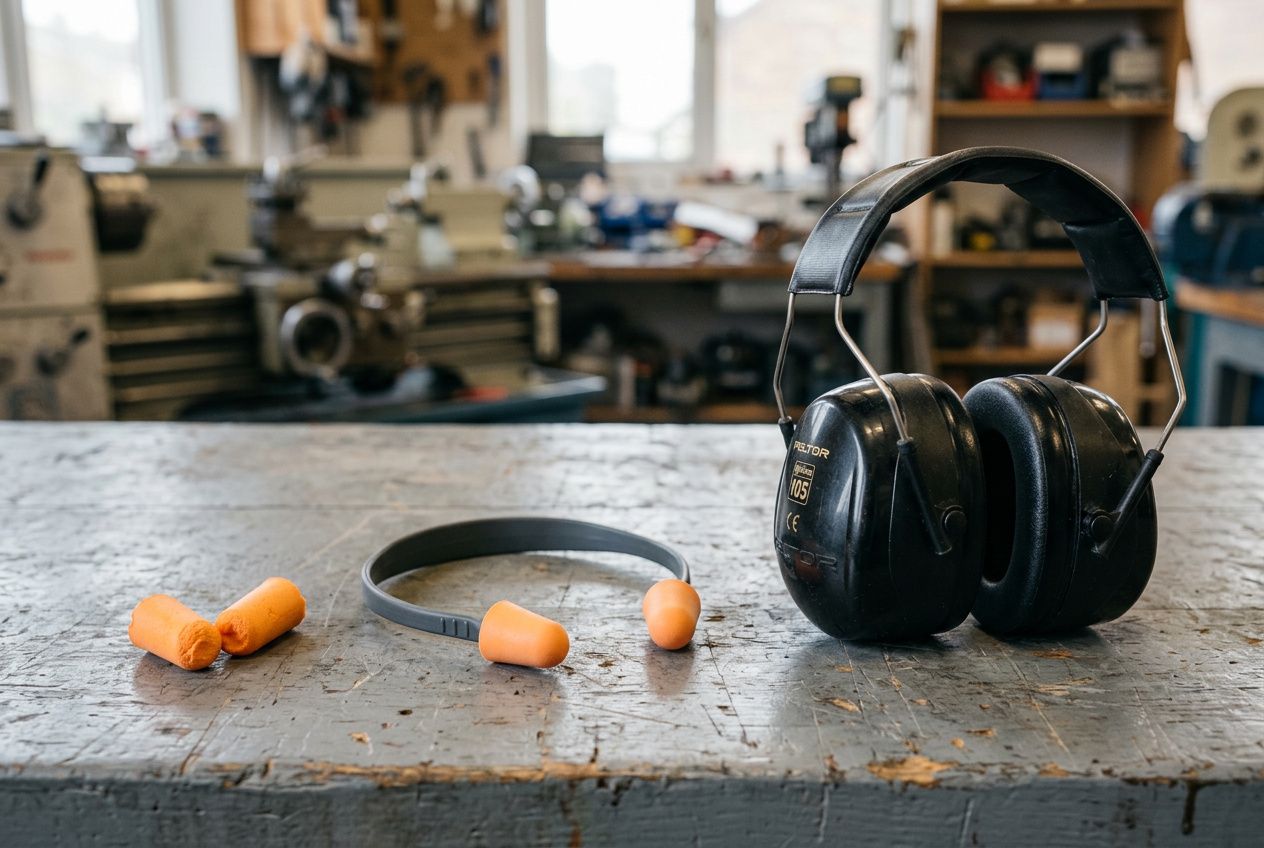
Disposable, reusable and custom-moulded earplugs
Earplugs remain the most common solution for hearing protection at work under continuous exposure. Foam models, such as the 3M 1100 series, are hypoallergenic and designed with a tapered shape that makes them easier to fit to the ear canal.
- Disposable foam earplugs: attenuation of 20 to 40 dB, disposable after use, no maintenance, suited to long exposure in manufacturing or on site.
- E-A-R™ UltraFit™ reusable earplugs: soft triple flange, fitted without rolling, adapts to different canal sizes, controlled cost of use if cleaning is followed.
- Custom-moulded protection: moulded by a hearing care professional, very good comfort, washable, possibility of integrating an electronic acoustic filter: higher initial investment, but worthwhile over time.
Once the type is identified, the difference lies in how the plug contacts the ear. Silicone plugs sit at the entrance to the canal: comfort is often better, but effectiveness is generally limited to 15 to 20 dB. Conversely, foam earplugs offer broader noise reduction, provided they are inserted correctly and, for disposable references, renewed every day.
Banded earplugs and ear defenders in industrial environments
When removals are frequent or peaks are marked, banded earplugs and ear defender cups take over. Headband ear defenders reach up to 35 dB of attenuation and suit sudden rises in intensity. Helmet-mounted versions, compliant with the EN 352-3 standard, have an SNR of 25 to 30 dB and meet the constraints of construction well.
In addition, some electronic ear defenders add functions that are useful in real conditions. The Peltor™ Protac™ III and Bluetooth WorkTunes™ Connect attenuate dangerous noise while letting useful sounds or communication through.
| Type | Attenuation | Preferred use | Standard |
| Disposable foam earplugs | 20-40 dB | Long continuous exposure | EN 352-2 |
| Reusable earplugs | 25-33 dB | Intensive use, hot environments | EN 352-2 |
| Banded earplugs | 20-28 dB | Intermittent noise, quick fitting | EN 352-2 |
| Headband ear defenders | Up to 35 dB | Intensity peaks, prolonged use | EN 352-1 |
| Helmet-mounted cups | 25-30 dB | Construction, dual protection | EN 352-3 |
| Electronic / Bluetooth ear defenders | SNR 31 dB | Communication in noisy environments | EN 352-1 |
Choosing hearing protection by use case
The nature of the noise, continuous or intermittent, remains the first criterion for choosing hearing protection. Once this is established, the choice depends on exposure, the sector, the ambient temperature and communication needs at the workstation.
Intermittent noise vs long continuous exposure
In every professional use case, the duration and frequency of exposure directly guide the choice. For intermittent noise, such as workshop visits, inspections of production areas or occasional assembly operations, banded earplugs work well: they go on and come off quickly, without handling in the ear canal. Conversely, for continuous exposure in manufacturing or heavy maintenance, earplugs generally offer better comfort over time.
- Intermittent noise: 3M™ 1310 banded earplugs, quick to fit, worn under the chin or behind the neck, replaceable soft foam tips, suited to production areas and logistics warehouses.
- Continuous exposure: 1100 series foam earplugs or reusable UltraFit™, prolonged wear without a feeling of pressure, certified attenuation, usable over an eight-hour shift.
- Mixed workstations: electronic or Bluetooth ear defenders, dynamic management of the ambient noise level, attenuation during peaks, communication maintained during quieter phases.
For a bulk purchase, segmenting by workstation remains safer than imposing a single model. Refusals to wear protection then decrease and safety gaps narrow, especially when exposure profiles to noise vary widely.
Construction, industry, hot environments and communication needs
In construction and industrial environments, compatibility between PPE immediately weighs on the choice. With an EN 397 safety helmet, favour helmet-mounted ear defender cups compliant with EN 352-3. Earplugs remain compatible, but they do not follow the same logic of integrated equipment.
Depending on the working atmosphere, perception changes quickly. In hot and humid environments, such as foundries, outdoor work in summer or the food industry, ear defender cups often become less comfortable. Washable reusable earplugs or light banded earplugs are then suitable hearing protection, with a certified attenuation filter that stays stable if maintenance is followed.
- Construction and sites: cups mounted on an EN 397 helmet, SNR of 25 to 30 dB, combined head and hearing protection.
- Food industry / humid environments: washable reusable earplugs with a metal-detectable option, light and practical for continuous wear.
- Workstations requiring communication: WorkTunes™ Connect ear defenders (SNR 31 dB, 40 h battery life, hands-free microphone) or Peltor™ Protac™ III for environments with dangerous noise where safety signals must be heard.
To refine the selection, a trial with a panel of users remains worthwhile before ordering in volume, especially for mixed or continuous-wear workstations.
SNR and noise attenuation: how to read the key figures
Before comparing ear defenders or earplugs, you need to read the acoustic indicators correctly. Three levels of reading appear on certified data sheets: the SNR, the H-M-L values and the analysis by frequency band. The choice depends on how complex the noise is and how precise you need to be.
Calculating the minimum SNR for your exposure level
The SNR (Single Number Rating) expresses an average attenuation in decibels, for all types of noise combined. It is the most useful benchmark for an initial selection. The calculation is simple: measured ambient noise level, minus the target safety level, in practice between 70 and 80 dB, gives the minimum SNR to choose.
A practical example: a metalworking shop measured at 100 dB(A), with a target of 75 dB, requires an SNR of at least 25 dB. A model rated at 31 dB therefore covers the exposure with a sensible margin. Conversely, equipment rated at 35 dB used in an 85 dB environment can harm comfort and needlessly isolate the operator from useful signals.
- SNR < 25 dB: suited to environments between 80 and 90 dB(A), for moderate exposure with light banded earplugs or silicone plugs.
- SNR 25-31 dB: the standard range for most industrial workstations, manufacturing, joinery or maintenance; covers common needs up to 107 dB(A) with a 75 dB target.
- SNR > 31 dB: to favour in very noisy environments, such as hammering, some welding operations or oil sites; you then need to check that over-protection does not reduce the perception of safety alerts.
In real conditions, wearing time directly changes effectiveness: protection rated at 31 dB worn only 90% of the time protects less well than a 25 dB solution worn continuously.
H, M, L and frequency bands to go further
Noise attenuation is not the same across the whole spectrum. The H, M and L values specify how a filter or protector behaves on high, medium and low frequencies. The difference lies in the character of the noise being treated: a diesel engine loads the low frequencies more, while a grinder mainly loads the high ones.
Once the type is identified, analysis by frequency band clearly refines the choice: from 63 to 8,000 Hz, each octave shows the attenuation obtained. Relying on the SNR alone can then under- or overestimate the protection actually needed against the noise.
At complex workstations, stamping presses, drilling, sandblasting or multi-source areas, ear defenders or an earplug with a dedicated acoustic filter will be more effective, without compromising comfort or the ability to hear safety signals.
Comfort, compliance and EN 352 standards for buying well
The regulatory compliance of hearing protection is checked before purchase, directly on the packaging: the applicable EN 352 standard must appear unambiguously. This determines the validity of the equipment in the event of an inspection, a health and safety audit or a workplace accident.
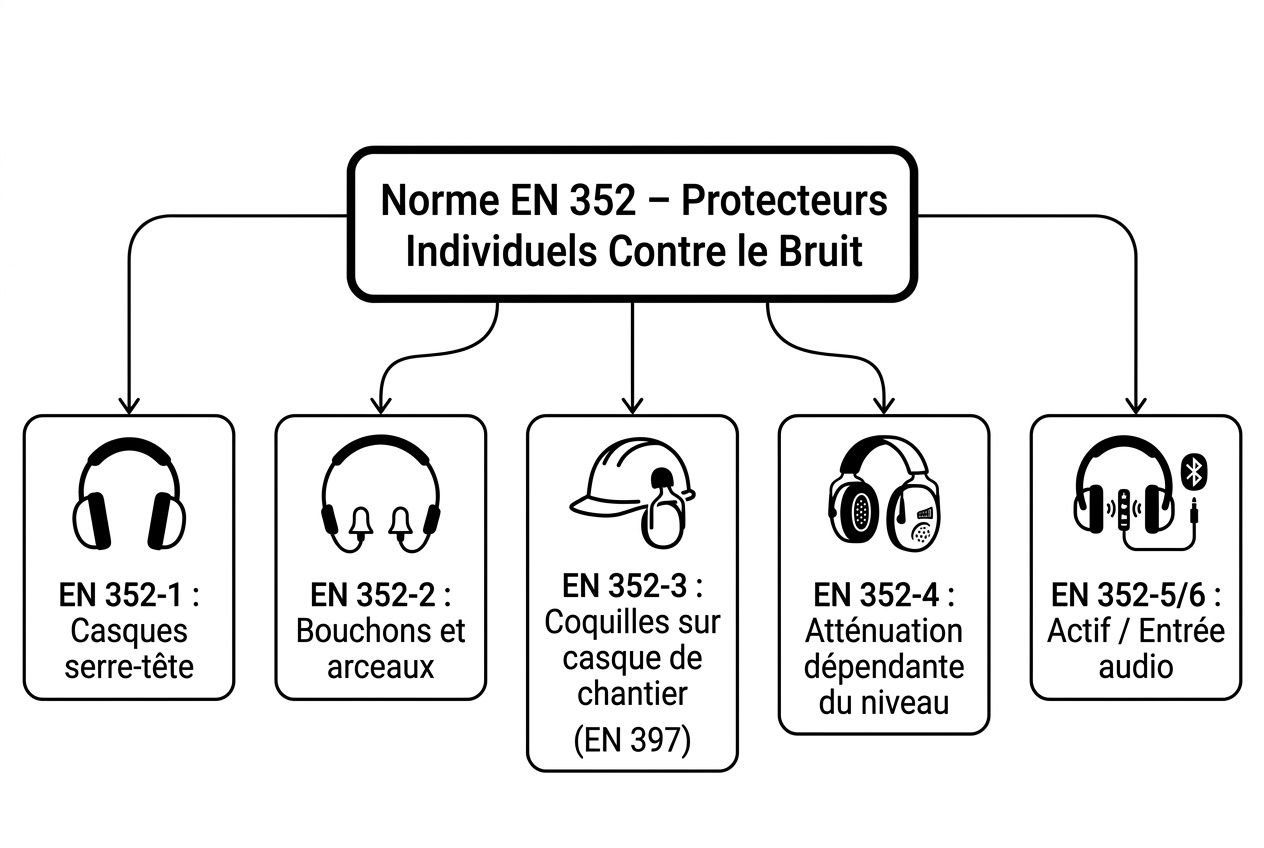
The EN 352 standards to check for your hearing protection
The wearing comfort of hearing protection and compliance go hand in hand. EN 352 compliance organises certification by type of equipment, with separate requirements for each use.
- EN 352-1: headband ear defenders with cups, to favour in industrial environments with high exposure and for prolonged wear.
- EN 352-2: earplugs and banded earplugs, lighter, suited to hot environments or occasional use.
- EN 352-3: cups mounted on an EN 397 site helmet, to combine head protection and hearing protection, with an SNR of 25 to 30 dB.
Parts EN 352-4 to 6 cover level-dependent protection, active systems and devices with an audio input. For group purchases, traceability comes first: requiring the standard reference on every purchase order makes internal audits easier and secures PPE monitoring.
Comfort, size and durability for lasting team equipment
In real conditions, it is comfort that determines actual wear. When an operator removes their protection for a few minutes every hour, their exposure level rises quickly, even with a theoretically suitable SNR.
To last over time, several technical choices make the difference: provide several sizes of earplugs, notably for narrow canals, choose banded earplugs with replaceable tips and select hypoallergenic materials. Renewal costs then fall and acceptance of wearing improves. A trial with a small panel before ordering in volume remains a reliable method in the workshop to limit returns.
What the regulations say about hearing protection
In France, hearing protection is PPE within the meaning of the Labour Code. Its use is therefore not a simple recommendation but rests on precise obligations linked to the noise level and employees' exposure. For a B2B buyer, these thresholds are used to size the equipment and prepare the documents expected in the event of an inspection.
The three legal thresholds companies need to know
The regulations on noise at work rest on three benchmarks. From 80 dB(A), the employer must inform and train exposed employees, and make suitable hearing protection available. From 85 dB(A), wearing becomes compulsory and noise reduction actions must be undertaken. The limit value remains set at 87 dB(A), taking into account the attenuation provided by the protection worn.
- 80 dB(A): information and training for exposed employees, hearing protection made available.
- 85 dB(A): compulsory wear, collective noise reduction measures, enhanced medical surveillance.
- 87 dB(A): maximum exposure limit taking PPE attenuation into account; any exceedance requires immediate correction.
- Noise-dose relationship: 92 dB(A) for 30 minutes, 86 dB(A) for 2 hours and 80 dB(A) for 8 hours carry comparable hearing risks. This is decisive for adjusting protection to shift rotations.
These values concern average daily exposure, but average daily exposure is not the only criterion to monitor. With impulse noise, as on presses, in cutting or welding, the peak level must also be checked: 140 dB(C) is a separate limit, even if the average level remains lower.
How to assess your teams' real exposure
Once the thresholds are set, the field assessment becomes the starting point. The regulations on noise at work require this assessment before any PPE order. In the workshop, a simple indicator gives a warning: if an employee has to raise their voice to speak to someone one metre away, the noise level often exceeds 85 dB(A).
This benchmark does not replace measurement. A sound level meter reading quantifies the real noise intensity, estimates exposure by workstation and defines the SNR needed. The choice depends on this calculation: too low a rating does not protect enough, too high a rating can hinder communication and the perception of warning signals.
Once the regulatory basis is in place, the chosen method must be documented. To structure the approach and document decisions, this document from DREETS Pays de la Loire (in French) details measurement methods and selection criteria.
Frequently asked questions
How do I choose hearing protection for my working environment?
Three criteria come first: the noise level measured in dB(A), the type of noise and the duration of exposure. The choice depends on the real noise environment: continuous noise, intermittent peaks, the need to talk with the team or stay alert to alarms.
For an intermittent noise level, banded earplugs or earplugs may be enough. For continuous exposure, however, ear defender cups or reusable models offer more consistent attenuation over time. If communication remains essential, aim for hearing protection compatible with that use, with a clearly stated SNR and EN 352 compliance.
What is the difference between disposable and reusable earplugs?
Disposable foam earplugs are compressed before insertion, then expand back in the ear canal. They suit simple daily use well, with no maintenance, replaced regularly to preserve hygiene and safety.
Reusable models work differently: softer or firmer material, flanges, washing after use and reuse if their condition remains good. You then need to look at shape, size and consistency of wear in the workshop. Reusable earplugs are best for fixed workstations with a cleaning routine, while disposable foam earplugs remain practical for rotating teams.
What is the SNR and how do I use it to select protection?
The SNR indicates the overall attenuation of hearing protection, expressed in decibels. This value is compared with the noise level measured at the workstation to obtain the residual exposure.
The calculation is simple: start from the ambient noise, then aim for a residual level compatible with the work and with safety, often between 70 and 80 dB. A workstation at 98 dB(A), for example, will require an SNR of at least 23 dB to bring exposure down to around 75 dB. It is therefore better to avoid over-protection: excessive attenuation cuts the wearer off from the noise environment and makes it harder to perceive useful signals.
From what noise level is wearing hearing protection compulsory?
In France, hearing protection must be made available from a daily exposure of 80 dB(A). Wearing becomes compulsory at 85 dB(A), and the exposure limit value remains set at 87 dB(A), with protection taken into account.
Peak thresholds are added to this logic: 135 dB(C) for the lower action value and 137 dB(C) for the upper one. The choice is therefore based on the noise level, the duration of exposure and the applicable standard.
How can I make sure the chosen hearing protection complies with the regulations?
The first point to check remains the standard shown on the packaging. EN 352-1 covers headband ear defenders, EN 352-2 earplugs and banded earplugs, and EN 352-3 helmet-mounted ear defender cups.
In addition, the product data sheet must show the SNR as well as the H-M-L values. Technical documents and PPE declarations should also be kept, especially for group purchases or real health and safety inspections. The 3M banded earplugs offered on the site meet these criteria, with compliance information available on their product page.
Recommended products
- 3M™ WorkTunes™ Connect Bluetooth® 90543E ear defenders
- 3M™ Peltor™ Protac™ III MT13H221A ear defenders
- 3M™ Peltor™ Optime™ III ear defenders
- 3M Peltor X4A ear defenders
- 3M™ Peltor™ X5A ear defenders
- 3M™ 1100 series earplugs
- 3M™ E-A-R™ UltraFit™ earplugs
- 3M™ Peltor™ EEP-100 EU electronic earplugs, green
- 3M™ 1310 banded earplugs
- Coverguard® Earline® 30230 banded earplugs
- 3M™ E-A-Rcaps™ banded earplugs